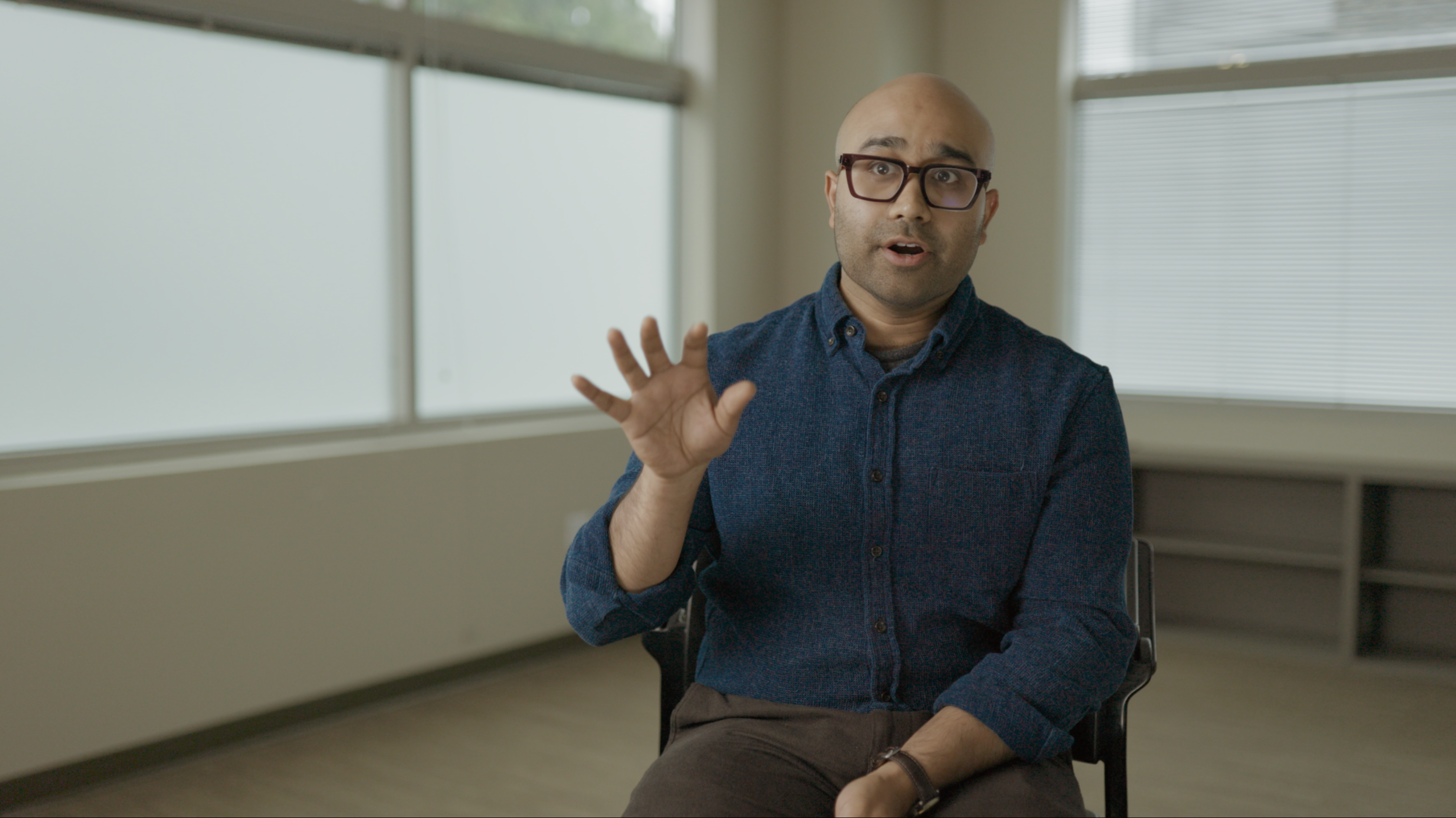
After shooting with the Canon C400 for more than a year, mostly in XF-AVC, I hadn’t really noticed noise to be much of an issue. But recently I’ve been shooting raw a lot more often, and I’ve been surprised by the amount of noise, really ugly noise, that leaps out from the shadows when exposing “correctly” even at ISO 800.
This tends to show up, for example, in an interview shot like the one above where someone is wearing a dark outfit. Everything looks great except the dark outfit is bristling with noise on closer inspection (see 2x short clip below). This can be tamed in post by adding some de-noising, but it’s not a real solution and denoising in post always slows things down.
I did some testing and it turns out that a genuine fix is obtained by overexposing everything two stops. The best way to think of this is to set the camera at 3200 native iso, and think of it as being set to 800. To be able to work with the image in the monitor, I created a +2-stop compensation LUT to make it appear normal, and boom, problem solved. (Download link below).
At the camera’s native 3200 setting, the shadows are very clean when the raw footage is overexposed 2 stops. Even at 128000, while there is now some noise present in the shadows, it’s still very usable and organic. But 3200 is definitely the sweet spot here for shooting raw on the C400.
By way of comparison, I ran the same test on my C500mkii. This camera has just one base iso of 800, so if it needs overexposure compensation it will be more of an issue in low-light situations than the C400 with its higher triple-base ISO rating options.
Result: The shadows are about half as noisy, but it’s a finer less ugly noise than the C400. The C500mkii needs +1 exposure comp to clean up the shadows in a roughly equivalent way to the C400 with its +2 stop requirement.
So there you have it. To get clean raw footage and match these cameras when shooting raw, I now use a +1 exposure compensation LUT with the C500mkii, and +2 with the C400. When I bring the footage into Resolve, the first thing I do after setting up a color-managed workflow is to bring down the footage on each camera using the HDR global level control, which displays real f-stop values, -2 on the C400 and -1 on C500mkii. And away we go, sharp and clean.
Download my exposure compensation LUTs for C500mkii and C400. Note these both use the Canon Monitor Transform (CMT) version of the Canon LUT which is best for on-set viewing while shooting Clog-2.
I spent a few hours with Matt Lawrence, the owner of Camp Colvos craft brewery, over the weekend and made this launch video for their new dry Irish stout. Even though I’ve been shooting with the Canon C400 for almost a year now, it’s the first time I’ve had a chance to really dig into shooting at 120fps.
I only had one light with me, so I shot everything at base ISO 3200, to take advantage of the autumnal grey light coming through the window. That one light is my new favorite, the ultra-portable Small-Rig 220C. I love it because it has built-in ballast, is small and light. Just pop on a v-mount battery and go. I mostly bounced it into the wall behind the bar to get a soft warm glow which contrasted well with the cool window.
This camera has so much to offer with its three base ISOs, 120fps 4k and box camera shape that I love so much. Most of this shot with the amazing 24-105 f/2.8 Canon RF zoom, which lives on the camera. The macro shots were made with the 100mm EF macro f/2.8 that I’ve owned for years, and use with RF adapter on the C400. Cut in Davinci Resolve with Dehancer Pro Kodak Gold 200 film curve.
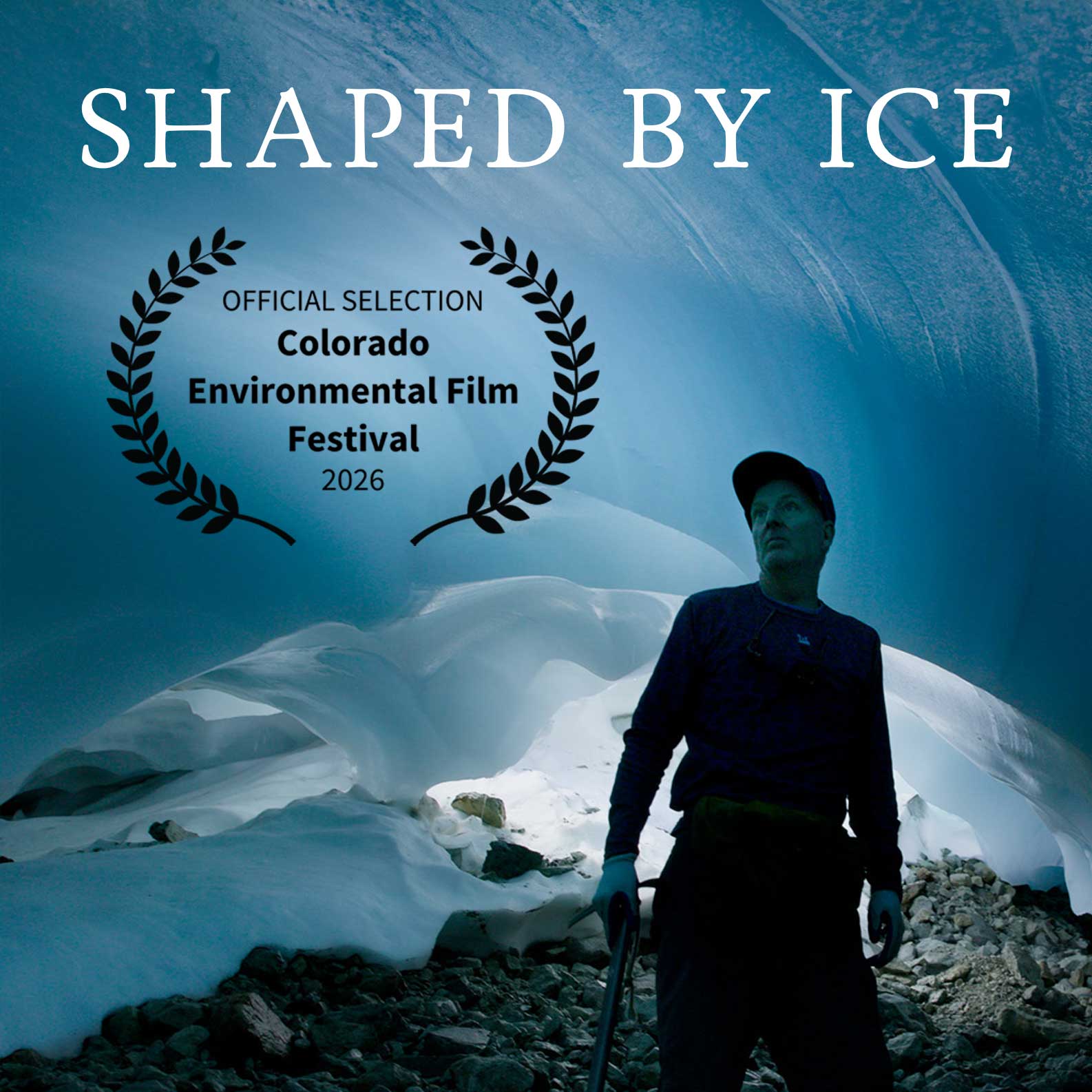
Shaped by Ice continues its festival run and will screen February 20-22, 2026, at the 20th annual Colorado Environmental Film Festival in Golden, Colorado.
This is the third festival selection for this 5-minute long film about glaciologist Mauri Pelto and his daughter, Jill, who translates their scientific findings into paintings that tell a data story through graphs overlayed onto glacial landscapes.
The film will also screen at the Backcountry Film Festival, with screenings cities across the US and Canada. It premiered as a finalist at the Bloomberg-Greendocs festival at the Seattle Art Museum in July, 2025.
During the summer of 2025 I joined the Pelto’s and their posse on Mt. Baker where we spent a day huddled in our tents trying to stay dry. The weather cleared the next day allow us to ascend on the glaciated shoulder of the mountain to continue the grim work of documenting the accelerating loss of ice. The footage I shot will ultimately become part of a long-term project I’m doing to document the final 7 years of the 50-year project that Mauri launched in the early 80s. I’m planning to shoot every year leading up to the end of the study. One of the film’s dramatic questions will be whether Mauri’s body will hold up long enough to allow him to reach his goal. And mine, for that matter! Luckily for me, I’ve got a crew much younger than I am who can keep shooting even if I have to stay back in the edit bay. But my goal is go shoot most of this myself. As always, I’m happiest with a camera in my hand, working on small projects that can make a big impact.
My latest film commissioned by UW Medicine features Charles Burt, an artist whose Parkinson’s diagnosis seemed destined to spell the end of his career. But a surgical team was able to quiet the tremors in his hands using deep brain stimulation, a surgery in which the patient has to be awake to ensure proper placement of electrodes within the brain.
The creative team at UW Medicine was able to get me and my small crew into the surgical suite to film the operation, which was unnerving! Charles was speaking with his doctors throughout the surgery, and the climax of the film is when they apply stimulation to the electrodes and ask him to draw something.
I couldn’t have done this project without the amazing team I work with, Jamie, Jenny and Zack, at UW. They brought me in early on this project so I was able to film Charles attempting to paint before the surgery, with tremors that made his work almost impossible. And then after the surgery, the contrast couldn’t be more striking.
This is the kind of work I (as a cancer patient myself) was born to do: to tell stories about the men and women who dedicate their lives to helping patients like Charles and me to live their best life. As long as we can.
The Bloomberg Greendocs festival was next-level awesome. Not only was it an honor to have my short film, Shaped by Ice, selected as one of five finalists, but the four other finalist filmmakers have given me a renewed enthusiasm for continuing to focus on environmental work. I’m leaving the festival with what feels like friends for life.
From left to right: Finalists filmmakers Thomas Klaper (winner!), Ángel Linares, Carter Kirilenko, Dan McComb and Gideon Mendel.
We all liked each other so much that we proposed the idea of sharing the $25,000 prize (over drinks the night before). The jury quashed our idea when Gideon presented it to them, and after seeing all the films, I believe I know why. It’s because Thomas’s film about migrating toads in Switzerland, which took 4 years to make, truly deserved to be the winner. Its use of humor and absolutely stunning cinematography, as well as the fact that it focused on a subject so small as to be invisible, was moving. Go Thomas and team! What an honor to share the stage with these four.
I also made some potential fundraising contacts for my Afterdrop project, which was the genesis of Shaped by Ice. And I’m on the hunt for more stories, particularly about scientists who are continuing to do the important work they do in the face of increasingly difficult and openly hostile environment to the truth of their work.
I’m honored to be one of five finalists in the Bloomberg Greendocs film festival, which is being hosted in Seattle this year. My short film about glaciologist Mauri Pelto and his daughter Jill, Shaped by Ice, will screen at Seattle Art Museum on July 16.
Shaped by Ice is an Afterdrop spinoff. Originally I wanted to find a way to link glacier science with the ice swimming record that Melissa Kegler was attempting to break. That project was unable to secure funding, but I’m thrilled this one is finding an audience and bringing attention to the vitally important work that climate scientists do.
The North Cascade Glacier Climate Project begin in the early 80s when a then 20-something Mauri Pelto began visiting a group of about a dozen glaciers in the North Cascades. His idea was to return 50 years in a row to document how those glaciers respond to climate change. The results have been sobering: two of those glaciers no longer exist, and in the 42 years he’s been visiting the glaciers, they have documented a 30 percent loss of ice.
I hope to see you at SAM on July 16 – here is your registration link so you can join us.
It’s been months in preparation, and now it’s official: the campaign to raise production money to send our small team to Alaska to film Melissa Kegler on her quest to set a new world record is now live!
We’re raising $42,000 which is enough to send a crew of 3 (two filmmakers and Melissa) to alaska for two weeks in June, during which time we’ll meet with glaciologists and learn what’s happening to Alaska’s big tidewater glaciers while Melissa seeks the perfect water temperature – just under 41 degrees Fahrenheit- to make her attempt.
As it turns out, the United Nations General Assembly proclaimed 2025 as the International Year of Glaciers’ Preservation and established 21 March (today) as the annual World Day for Glaciers.
As scientists who study disappearing glaciers come under attack from the highest levels of government in the United States, I believe it’s on us to keep sharing their work. So I am making this documentary as much a climate film as it is a sports documentary.
There is a moment in every ice swim when the body begs to stop, when survival instincts scream for warmth, for safety. Melissa knows this moment well—she lives in that threshold, mastering the delicate balance between pushing forward and knowing when the cold is too much. This is the razor’s edge where endurance becomes something more than physical. It is here, in this battle between strength and fragility, that Melissa’s journey reflects something far greater. Her struggle is not just about breaking records; it is about facing the unknown, about adapting, about enduring. As the world around her changes in ways we are only beginning to understand, her pursuit becomes a quiet but powerful reminder: resilience alone is not enough. The question is not how far she can go, but how much longer we have to hold on to the world as we know it.
I recently completed a project that involved shooting a half-dozen interviews in a location that had some nice depth and windows with interesting shapes. I’m really happy with the finished piece, which is the first project I’ve finished using the Dehancer plugin in Davinci Resolve to apply a film stock and grain. Here’s the finished video, and I’ll explain how it came together below.
During the shoot I placed the subjects so that the lights visible in the background provided motivation for the placement of our own lights. We used two: a key light and an edge light. We also used varying amounts of negative fill on the shadow side of these faces. Here’s an example of that on location:
You can see we’re using a 50cm CRLS reflector (#3) with a Dedo DLED-7 with parallel beam adapter bounced up from the floor as our edge light. For our key, we’re using a Snapbridge reflector with a 25cm #3 CLRS reflector, and you can’t see it in the shot above, but the key is an Aputure 500d with fresnel lens. The Snapbridge takes that fresnel beam and splits it into a nice combination of hard and soft light that I just love working with.
When I was close to finishing this project, no matter how hard I tried, I wasn’t quite happy with the way the skin tones were looking. Even after substantial color correction in Resolve, I felt like the faces looked a little too colorful for my taste. Just then, by coincidence, I got an email from Dehancer asking me if I’d like to review their film emulation product, Dehancer. The timing was perfect, so I said yes.
The results really impressed me. Check out the before and after frames, and then I’ll explain the settings I used to get these results:
Before Dehancer. Looks pretty good, to be honest and I’d be OK shipping this. But…After Dehancer, I like it more.
Here’s what Dehancer does for me:
Color compression in the skin tones. There is a lot of color in the first frame in those skin tones, and that takes a lot of adjustment to get right. The second one feels much more filmic to me in the skin tones. Not that every project needs to be filmic, mind you. But when you have a lot of talking heads back to back in a project, like this one does, color compression like this puts them all on the same wavelength and makes them feel related. There is also a general reduction in saturation that comes from the choice of specific film stock (Kodak Gold 200), which is down to personal taste.
Film grain. I find that a small amount of film grain added within the plugin gives a pleasing effect by “dirtying up the frame” a little. For this project, I chose just 2.8. Be careful not to overdo it – the default setting is WAY too much.
Vignette. The vignette tool inside Dehancer is superior to Davinci’s vignette tool, offering more control and super smooth gradations.
I started out by applying Dehancer to all the footage at once, using a Timeline node. But I noticed right away that the tight shots needed a different vignette shape from the wides, so I created a group for each, then added Dehancer to both Post-Clip groups.
Adding it to a Group saves you time because you can tweak the settings and affect all clips in the group, rather than having to apply them to every clip in your timeline. I was also thrilled to see Dehancer works nicely with Resolve color-managed workflows, like the one I use. It’s the first setting in the tool, Source, which also offers options like Rec 709, and a bunch of other options including log decoding for those of you not using color management.
The next tool in the interface is also I think the coolest thing about Dehancer, Film. There are a ton of options here. You can get a little lost auditioning different film stocks. But after playing with them for a bit, just a couple of options really did what I was looking for. You have to be careful here. Many of the film stocks frankly made the images look horrible. It’s important to choose the right stock for the project, and then you can tweak the settings to refine it. Make sure you like what you see when choosing one, or else you’ll be fighting it to get the look you want.
Dehancer offers a ton of ton of options if you want to go further in controlling your image from within the plugin. Personally, I prefer to use Resolve’s tools for many of the options provided in Film Developer, Expand and Print. But Film Compression gives a nice quick way of controlling highlight rolloff that I find super useful and fast. Overscan lets you add dancing sprockets to the side of your image, and Film Damage gives you dust and scratches for those times when you need a truly vintage look.
Before DehancerAfter Dehancer
Once you’ve dialed in a look that you like, you can save it as a LUT with the LUT Generator for pre-visualizing your look on location. For the documentary work that I do, I prefer to shoot with a standard Rec. 709 LUT for most projects, then dial in the look afterward. But for those of you more proactive than me, this could be very useful.
Before DehancerAfter Dehancer
For me, Dehancer doesn’t replace the already incredible tools that Resolve gives me to balance and color correct my work. But as a “last mile” tool to really dial in a filmic look, Dehancer is incredibly useful and a great way to achieve a result I would be hard pressed to achieve on my own.
Before DehancerAfter Dehancer
But clients are the ones who get the last word on every project. For this one, when I sent the Before Dehancer version, my client accepted the project without comment. After I sent the After Dehancer version, I got back three words: “This is beautiful!”
I’m thrilled that Ice Mermaid has been selected by Ocean Film Tour, a Germany-based documentary film festival whose program includes features on ocean adventure, conservation and activism.
Both Melissa Kegler and I are headed to Hamburg for the premiere, as well as two more screenings, including one in Vienna on March 7th. I’m super excited to have the opportunity to participate in this world-class festival!
The 42-minute documentary, Ice Mermaid: Cold Resolve, that I made about Melissa Kegler’s quest to swim farther and colder than any American is now streaming on KCTS. You can watch the trailer and stream the film via the KCTS 9 Passport app.
I’m thrilled that the film has received this distribution from PBS, and what’s more, I’ve recently learned that it has been selected for a major international film festival! More details on that coming soon in a separate post.
I first met Melissa a couple of years ago, when I was teaching a cinematography workshop at Seattle Film Institute. I wanted to give my students an opportunity to work with some high-quality footage, and I thought this topic might provide us that in an accessible environment for the class. I found an open-water swimming group on Facebook, and the page owner, Oscar Brain, agreed to let us film him doing an early-morning swim at Golden Gardens. Here’s the little film we made from that:
While we were filming this, Oscar kept mentioning this person named Melissa Kegler. She’d swum the English Cannel, around Manhattan, Catalina Island, on and on. So that made me curious about her. After this short video was published on the group’s facebook page, I noticed that Melissa liked it. So I reached out to her and asked if she’d be willing to be our second subject for the last half of the class. She agreed, and we made this little video together:
It’s worth mentioning that our inspiration for the making of both of these videos was the film Nomadland. We definitely sought to mimic the use of early-morning light used so effectively in that film. Astute observers may even note the presence, in Oscar’s video, of the same lantern as the one carried by Frances McDormand in the Badlands campground scene.
While we were filming Melissa, she mentioned that she was kind of thinking about tackling the US record for ice swimming. I thought that sounded like something worth a longer project, and she agreed. So that was how the longer documentary project got started.